Marilles produces the first guide to ecological restoration in the Balearic Sea
Published 08.07.2026
Share
Restoration only makes sense once the pressures that have caused habitat degradation have been addressed.
Marilles Foundation has presented the first Strategic Guide to Ecological Restoration in the Balearic Sea, a technical and informative document drawn up to establish a conceptual and practical framework for marine restoration applied to the Balearic Sea. The guide explains what marine ecological restoration is and isn’t, compiles case studies, and sets out criteria for identifying high-quality projects and avoiding initiatives that are merely symbolic or lack an ecological basis.
One of the key messages is that restoration only makes sense if action is taken to address the pressures that have caused habitat degradation: ‘Restoration is not a licence to continue destroying. The success of any restoration project depends, first and foremost, on eliminating the pressures that have degraded the ecosystems,’ explains co-author Margalida Monserrat.
Priority must always be to preserve ecosystems: ‘The science is clear: effective protection is the best method of restoration. Restoration only makes sense when pressures have first been reduced, and it is integrated into coherent planning, where protection and restoration go hand in hand, rather than working against each other,’ says co-author Nuria Salmerón.
Designed to serve as a reference guide for public authorities, conservation organisations, and businesses from sectors linked to the sea – such as tourism – which may fund future restoration projects, the guide provides a basis for promoting rigorous, ecologically coherent, and transparent interventions aligned with international standards.
To achieve this, it reviews key concepts, recommendations for good practice, and current legislation, as well as priority habitats and species. It also highlights various restoration initiatives in the Mediterranean and the Balearic Islands.
Written by Nuria Salmerón, a marine protected areas specialist at Marilles; Margalida Monserrat, a researcher for the Balearic Sea Report; and Tatí Benjumea, Habitats and Species Coordinator at Marilles Foundation, the publication of the guide addresses a pressing need.
The European Nature Restoration Regulation, adopted in 2024, sets out targets to restore at least 20% of degraded ecosystems by 2030, 60% by 2040, and 100% by 2050. To achieve this, EU member states are required to submit their National Restoration Plans by 1 September 2026. Consequently, numerous restoration initiatives are expected to emerge in the coming years.
‘Marine ecological restoration is an essential tool, but not all projects have the same impact. The resources dedicated to protecting our seas are limited; we must focus on initiatives that genuinely improve the state of the marine environment and avoid wasting money and effort. This guide helps to distinguish between restoration projects that deliver real benefits and those that do not,’ explains Aniol Esteban, director Marilles Foundation.
Debate: When and how to restore?
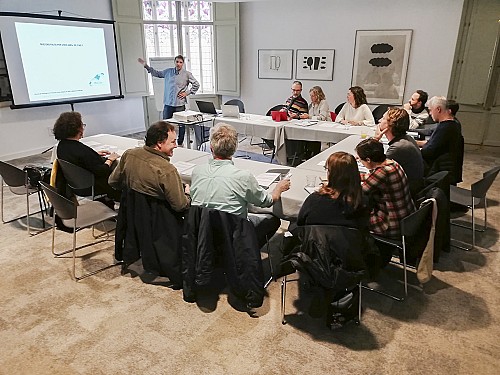
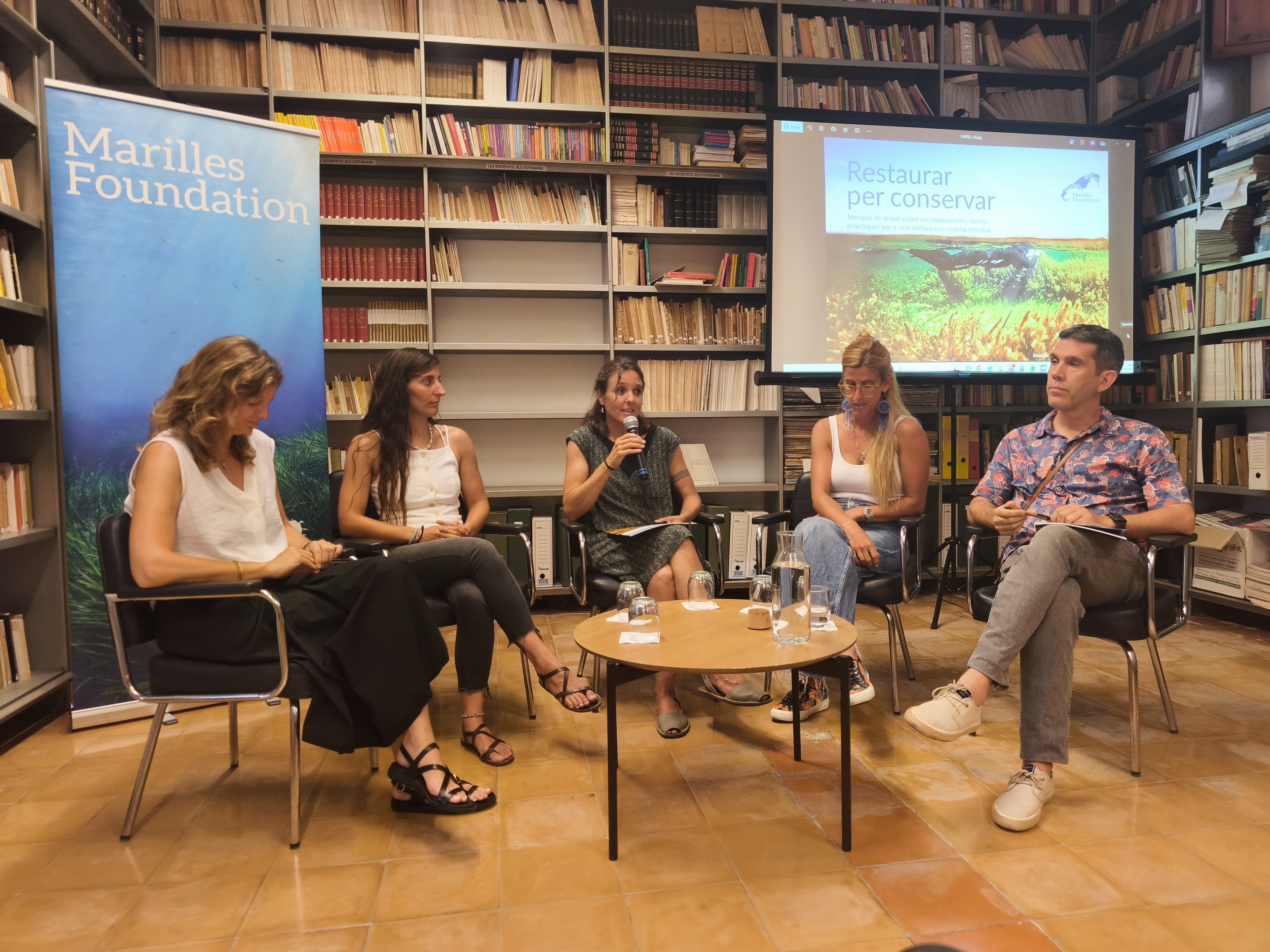
The guide was launched as part of the Restore to Conserve event, held on 7th July at the Estudi General Lul·lià (Palma). The event featured the participation of Silvia García Higuera, a specialist from Spain's Ministry of Ecological Transition (MITECO)’s Sub-Directorate-General for Marine and Terrestrial Biodiversity. It also included a debate ‒ Marine ecological restoration: can we recover what we have lost? ‒ which brought together scientists and experts Gigi Torras, from Arrels Marines; Inés Castejón and Beatriz Marín, from IMEDEA; Juan Calvo, from Alianza por el Agua; and Sonia de Caralt, from the University of Girona.
The event provided an opportunity to discuss best practices in marine conservation; share diverse perspectives on restoration; and call for marine restoration based on scientific criteria, focused on priority habitats and species, and taking into account the removal of the pressures that have caused their degradation.