Higher profits with lower catch volumes for the commercial fishing sector
Published 19.08.2026
Share
The 2026 Balearic Sea Report (IMB) updates the Benefits chapter, setting out the key indicators regarding the economic benefits that the marine environment provides to the Balearic Islands. The socio-economic indicators included in this chapter show that the services provided by a well-conserved sea remain essential to the islands’ economy.
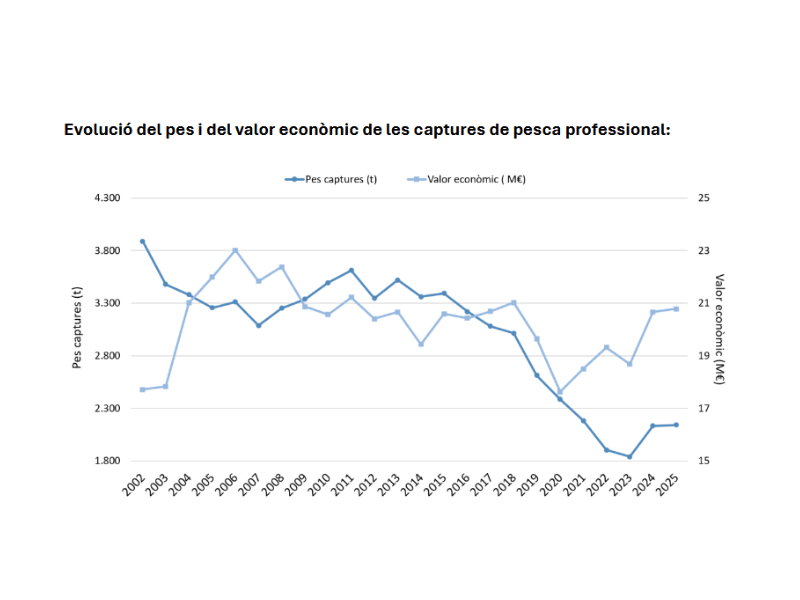
After reaching an all-time low of 1,839 tonnes in catch volumes in 2023, commercial fishing began to recover reaching 2,140 tonnes in 2025. Although the catch volumes remains below levels recorded two decades ago, their economic value has risen to €20.8 million (see graph).
More than 20,000 tonnes of fishery products are consumed each year in the Balearic Islands. Considering that fishery production in recent years has stood at around 2,000 tonnes, it can be said that around 10% of the fish sold in the archipelago comes from the local fleet, while the rest is imported (according to data from the Ministry of Agriculture, Fisheries, Food and the Environment, and the Balearic Federation of Fishermen’s Guilds).
Marine aquaculture (the captive rearing of saltwater species) continues to grow in terms of fry production, reaching a new all-time high of 48.5 million units in 2025, mainly consisting of sea bass and gilthead seabream. The sector also reached an economic value of €20.8 million in 2025, consolidating its position as a strategic activity within the Balearic blue economy, matched in value by catch volumes. In just over 20 years, its economic value has increased tenfold, rising from €2.1 million in 2003.
Recreational diving
Meanwhile, recreational diving continues to demonstrate the importance of well-conserved marine ecosystems as a tourist attraction. In 2025, the Balearic Islands reached the highest number of authorised centres to date, with 67 diving centres, 41 of which are located in Mallorca.
Dives organised by the diving centres on the islands are mainly aimed at tourists and take place primarily during the May‒October summer season. In general, Marine protected areas (MPAs) are more attractive to recreational divers, as they tend to feature fish species with more social behaviour, greater biodiversity, larger individuals, and better-conserved habitats with higher biodiversity. The diving sector is, therefore, a major beneficiary of protected waters and habitats in better ecological states.
Economic data from sectors that depend on the marine environment, such as fishing, diving, and other sectors linked to the blue economy, show that preserving the sea also means investing in the future of the Balearic Islands. The updated indicators from the IMB reveal that conservation policies, management of marine areas, and public engagement help maintain the ecosystem services on which numerous economic activities in the Balearic Islands depend.
Marilles in the media
- 27/10/2025 Ara Balears: "Milers de barques fermades a morts il·legals perjudiquen el fons marí"
- 12/08/2025 Ràdio Illa: "Marilles, sobre l’ampliació de la Reserva des Freus: “Si volem mantenir el peix local, s’han d’emprar aquestes eines”"
- 24/06/2025 Ara Balears: "Pesca confirma la legalitat d'una xarxa dins la reserva del Toro després que un vídeo incendiï les xarxes"