Marilles calls on the trawling fleet to end the killing of bluntnose sixgill sharks in the Balearic Islands
Published 20.05.2026
Share
Marilles is calling on the Balearic fishing fleet, and the trawling sector in particular, to put an end to the killing of bluntnose sixgill sharks that are accidentally caught. The bad practices of a few should not damage the reputation of an entire sector that is proving it is possible to fish less often while earning more. The bluntnose sixgill shark (Hexanchus griseus), known in Catalan as boca dolça, is common in Balearic waters. A scavenger, it lives at great depths usually feeding on dead animals. The main cause of shark mortality is interaction with deep-water trawling on slope grounds, where it is accidentally caught relatively frequently, although there is no reliable data available.
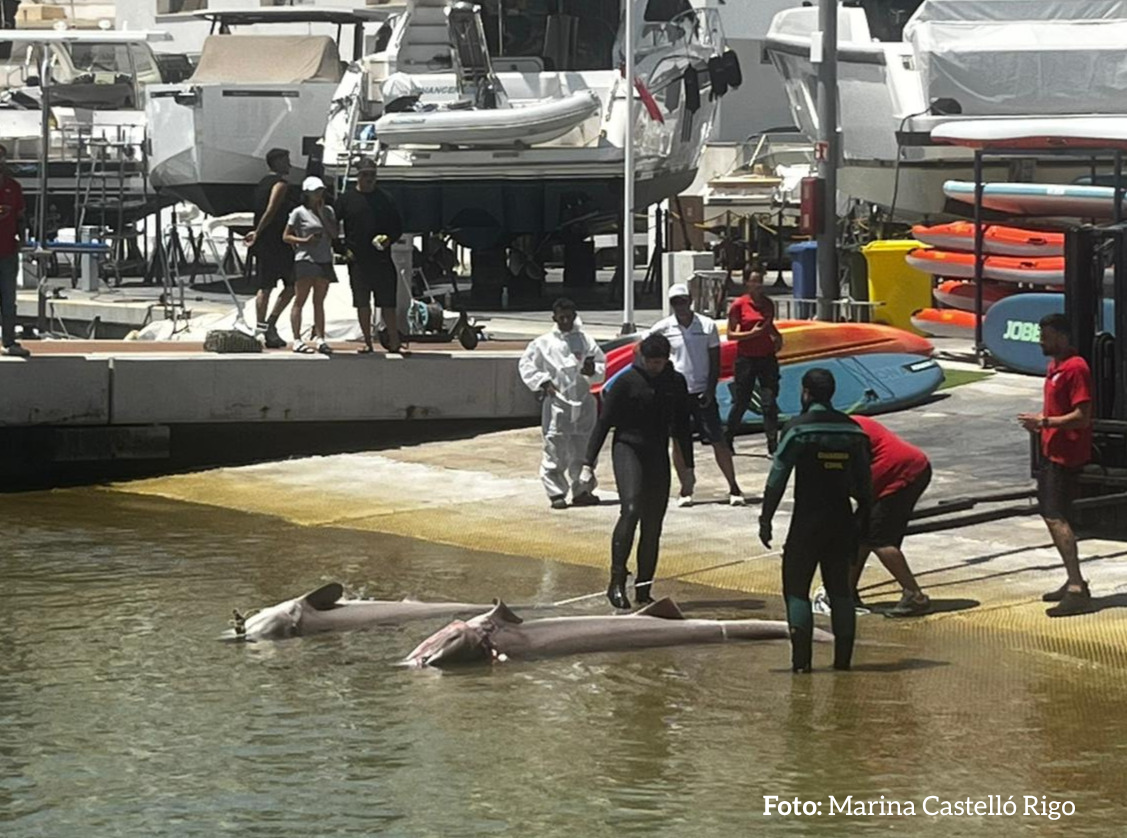
Unfortunately, some fishers still choose to kill these sharks once they are brought on board ‒ even though it is understood that releasing them can be difficult and complex. They are generally killed by a cut to the neck or spinal cord, the most common injuries found on these animals when they wash up on shore. This was the case with the two sixgill sharks found 19 May at Cala Nova, but also with previous cases at Can Pere Antoni (August 2025), Port Portals (2019), and El Molinar (2016). Every time a stranded shark appears with an axe wound or a cut to its neck or spinal cord, it undermines all the efforts the Balearic fleet is making to improve marine conservation, whether by reducing fishing days or supporting the creation of marine reserves. It also undermines efforts to create and strengthen high-quality, local and sustainable seafood brands, which as they evolve should also incorporate good environmental practices.
Ending the bad practices of a minority that damage the reputation of the responsible sector
It is within the power of the Balearic fleet to ensure that the sixgill sharks of 19 May 2026 are the last to be executed on board a Balearic fishing vessel. However, responsibility does not lie solely with the sector itself. Public administrations must facilitate and encourage the implementation of systems and protocols to avoid the accidental capture of these species and enable their safe release. They must also encourage the collection of data on accidental shark and ray catches to design measures to improve their conservation.
Solutions
If a vessel has a crane, sharks can be released once on board. In recent years, operations have been carried out to release large specimens that arrived alive on deck. The Balearic trawling fleet has developed systems to avoid the accidental capture of dead and decomposing tuna (discarded by the purse seine fleet), consisting of a heavy-duty net acting as a barrier. This system is still under development and has not yet received official government approval. If its use were authorised and implementation accelerated, it would help prevent a sixgill shark accidentally caught from becoming trapped at the bottom of the net, where its weight can destroy much of the catch. It would also facilitate the animal’s release.
We call for:
- All vessels in the trawling fleet to have protocols for the release of live-caught animals.
- All accidental catches of these animals to be recorded, including the condition in which they are released back into the sea.
- Administrative procedures to be accelerated to allow the installation of preventive measures that would avoid the capture of these animals and facilitate their release.
A fleet mistreated by Madrid (not by Europe)
The Balearic trawling fleet has not been treated fairly by the Ministry in the allocation of fishing quotas and fishing days. It has also suffered the impact of tuna discarded by the purse seine fleet in June and July, causing significant harm to the trawling sector while ignoring the waste involved in throwing tonnes of perfectly good tuna back into the sea.
Marilles has defended the Balearic trawling fleet on numerous occasions in the face of these injustices. We also recognise and welcome the management efforts that have reduced fishing days while improving catches and profitability. However, we cannot remain silent about a practice that has continued for far too many years. We cannot stand by waiting for another shark with an axe wound to wash ashore in the next few weeks, months, or years. The fishing sector has the opportunity to position itself as one of the most sustainable in the Mediterranean, and for the Balearic Islands to become a global benchmark in marine conservation. But none of this will be possible while these practices are tolerated.
More than half of Mediterranean and Balearic sharks and rays are threatened
A sea without sharks is not a healthy sea. Their presence is essential for the functioning of marine food webs, where they act as predators regulating the structure and balance of ecosystems. If the chondrichthyan species (sharks, rays and chimaeras) assessed regionally by the IUCN (67 out of 74 species) in the Spanish Mediterranean, 55.2% are classified under some category of threat. In the Balearic Islands, 54 species of chondrichthyans have been recorded; 31 are threatened, and 10 are considered locally extinct.